Why Hands-On Labs Change How Students Think
A STEM lab is not a room full of kits. It is a place where students learn how ideas behave in the real world.
10,000
Atal Tinkering Labs established across India

The first lesson of a maker lab is not electronics. It is that a student can change the state of something in the world and then understand why it changed.
The moment theory becomes visible
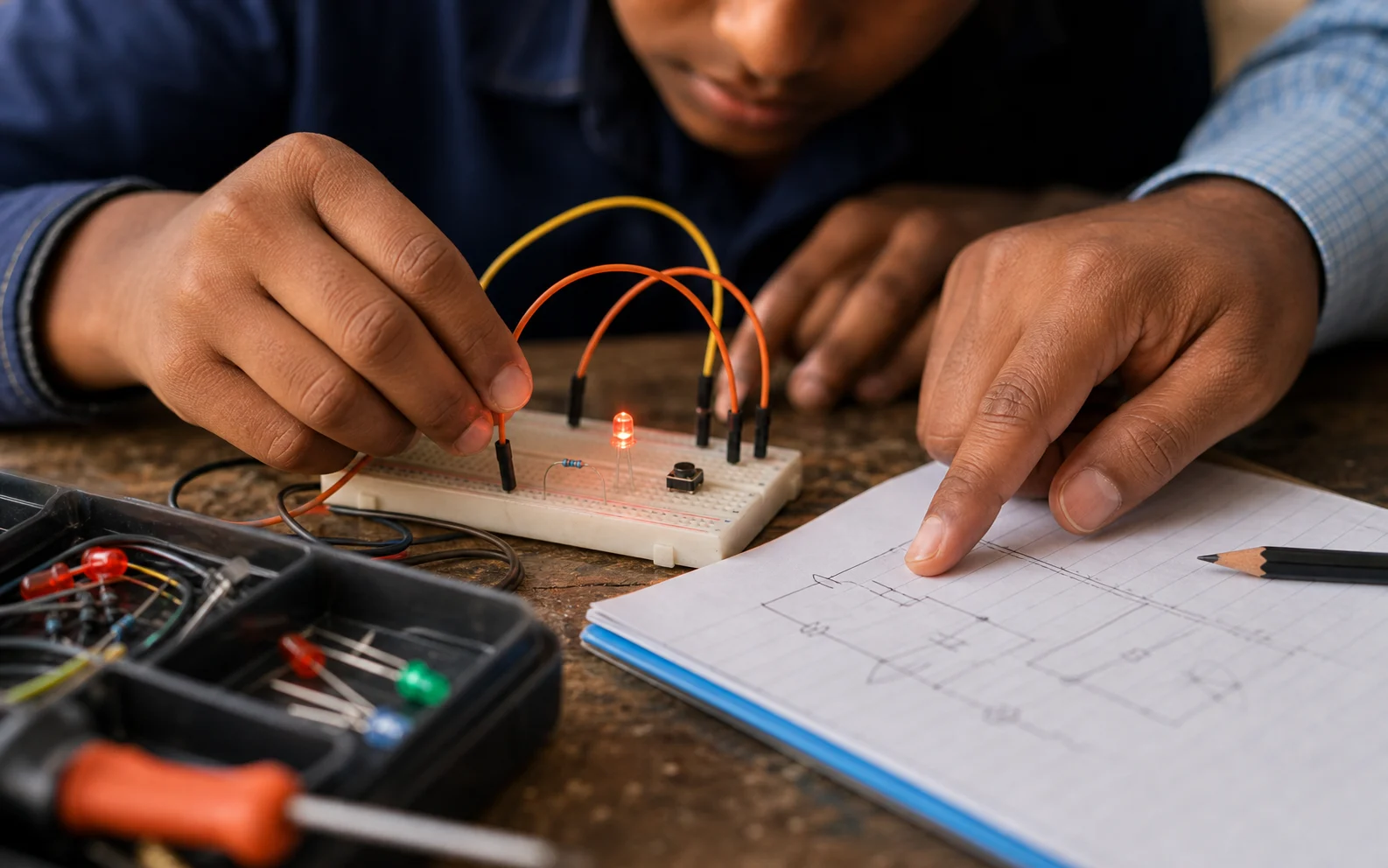
A student can memorize current, voltage, resistance, input, output, and feedback without ever feeling what those words mean. Then one day an LED refuses to glow. The wire is loose. The resistor is wrong. The battery is tired. Suddenly science is not a paragraph. It is a system that responds to decisions.
That moment is why hands-on STEM matters. It gives students a physical conversation with an idea. The circuit answers. The motor turns too fast. The sensor gives noisy data. The cardboard prototype collapses. Each response teaches a habit that exams rarely measure: look closely, change one thing, test again, explain what happened.
India's National Education Policy 2020 explicitly pushes education toward experiential, inquiry-driven, hands-on learning. The hard part is making that vision real in classrooms that have limited time, limited materials, and teachers already carrying too much.
Why Arduino-style projects work
Arduino and similar microcontroller platforms are powerful in low-resource STEM education because they sit between software and the physical world. Students write or modify logic, then see a real object respond. A blinking LED is simple, but it contains sequence, timing, electricity, syntax, debugging, and cause-effect reasoning.
A 2024 systematic review on Arduino in secondary education found that it is commonly used in technology and physics, supports interdisciplinary STEAM projects, and can increase motivation while developing soft skills such as problem solving. The review also notes an important caution: projects can become too difficult if they are not scaffolded well.
That caution matters for SFI. A rural lab should not begin with impressive complexity. It should begin with reliable wins and gradually increase difficulty. Blink an LED. Read a button. Control a buzzer. Sense light. Move a servo. Log a value. Combine two ideas. Then build something local.
The best projects start nearby
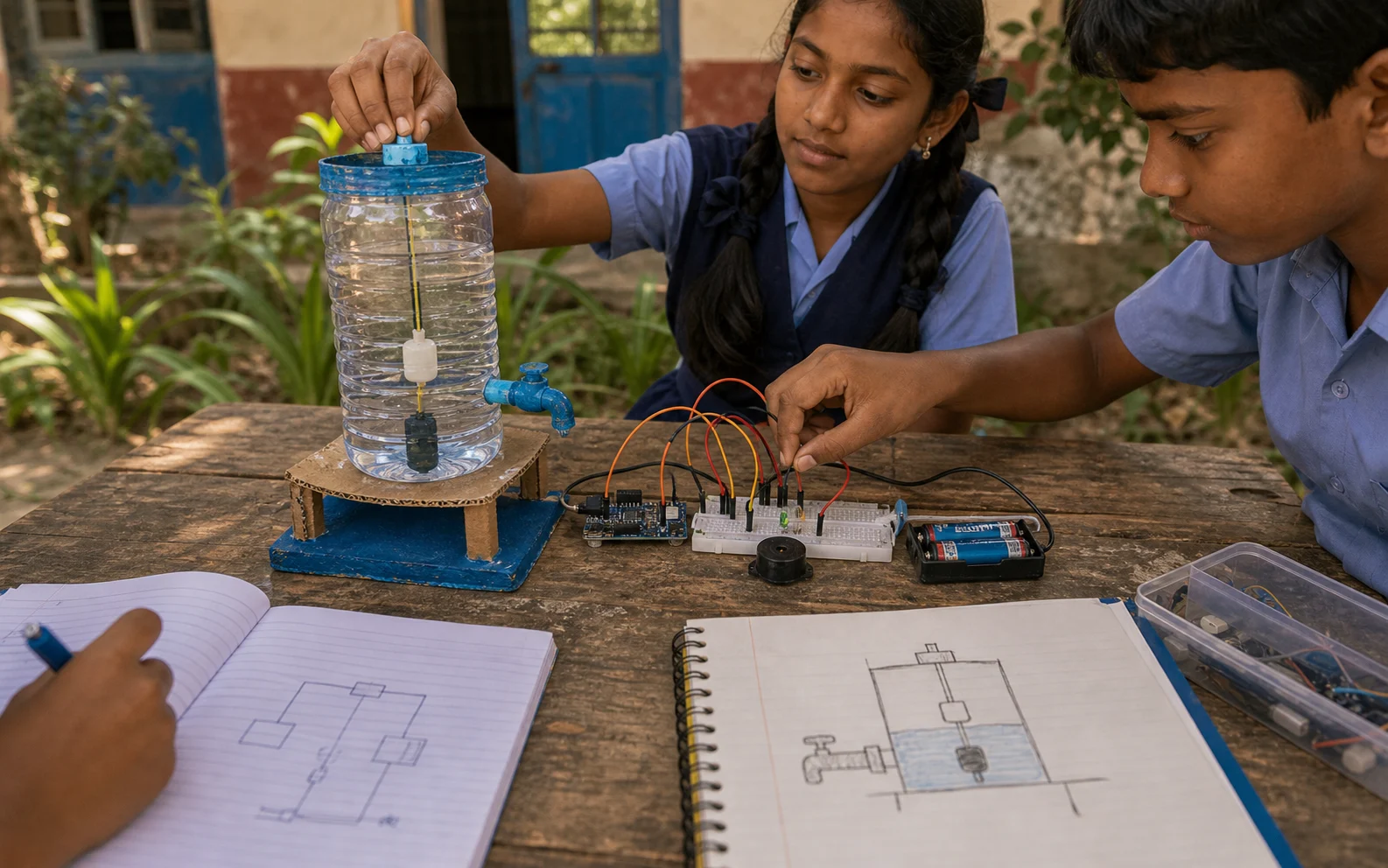
Rural students do not need imported problem statements. They are surrounded by engineering questions: water storage, crop timing, street lighting, heat, transport, animal safety, household energy, and school attendance. A good maker lab turns familiar problems into technical prompts.
A water-level alarm is not just a project. It is a discussion about tanks, wells, pumps, waste, sound, thresholds, and reliability. A soil-moisture indicator is not just a sensor. It is a conversation about farming, measurement, monsoon uncertainty, and when data helps decision-making.
This local grounding changes the emotional texture of STEM. Students stop seeing science as something that belongs to cities, exams, or English-medium confidence. They start seeing it as a way to ask sharper questions about their own environment.
- +Keep the first build small enough to finish in one session.
- +Make the second build a variation, not an entirely new topic.
- +Ask students to name the failure before the mentor fixes it.
- +End with public explanation, because confidence grows when students present their reasoning.
Labs need rituals, not just equipment
Many school labs fail because they are treated as procurement projects. Equipment arrives, photos are taken, and then the room slowly becomes a storehouse. A living lab needs rituals: setup, safety, roles, debugging, cleanup, reflection, repair, and showcase.
Atal Tinkering Labs show the national appetite for this kind of learning. AIM reports 10,000 ATLs across 35 states and union territories, reaching 722 districts and engaging more than 1.1 crore students. The next question is how to make the spirit of tinkering reach schools that are outside well-supported ecosystems.
SFI's advantage can be focus. A compact lab, a clear curriculum, a trained local facilitator, and mentor follow-up can do more than a large room with no operating rhythm.
What students really take away
The visible output may be a sensor, a robot, a blinking display, or a model bridge. The deeper output is a way of thinking. Students learn that systems can be understood. They learn that failure is information. They learn that tools are not magic. They learn that asking for help is part of engineering, not a sign of weakness.
That is why hands-on labs belong at the center of rural STEM work. They do not replace reading, math, or theory. They give those subjects somewhere to go.
Sources and further reading
Read next
All notesWhy an Arduino Simulator Belongs in a Rural STEM Lab
How browser-based circuit simulation can protect limited kits, help teachers explain invisible logic, and give rural students more chances to practice.
Village Problems Make the Best STEM Projects
Why rural maker education should start with familiar problems and guide students toward prototypes they can explain to their own community.