Village Problems Make the Best STEM Projects
A water tank, a dim street, a thirsty plant, or a long walk to school can become the beginning of a serious engineering lesson.
10,000
Atal Tinkering Labs reported across 722 districts

When the problem comes from the child's own street, field, school, or home, STEM stops feeling imported and starts feeling useful.
The best project brief may be outside the classroom
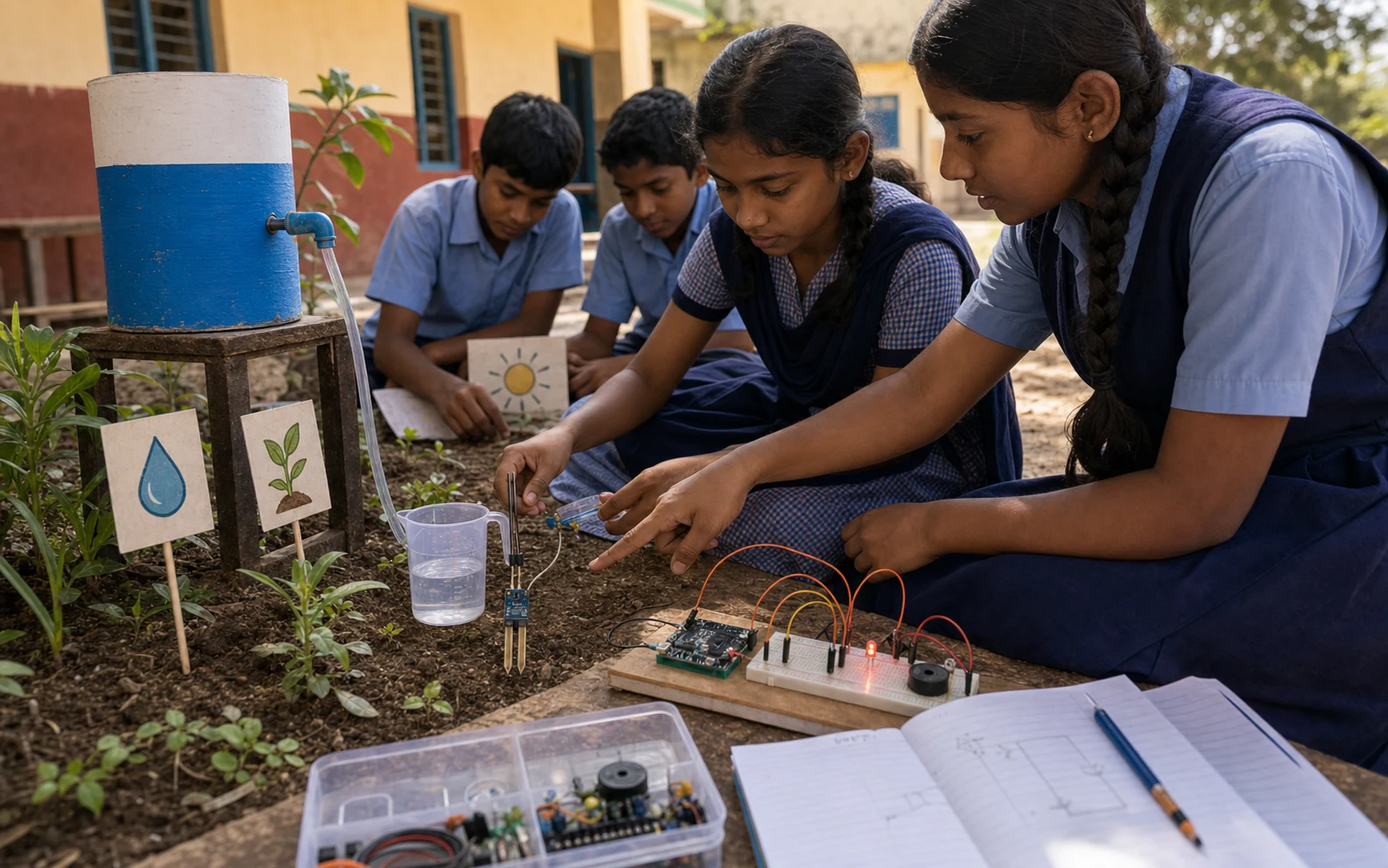
A village is full of engineering prompts. The school water tank overflows. A path gets too dark after sunset. A classroom becomes too hot by noon. A farmer wants to know when the soil is dry. A child sees these things every week, but nobody has called them STEM yet.
That is the opportunity. A student who builds a soil-moisture indicator is not only learning sensors. The student is learning how to observe a local need, measure a condition, make a decision rule, and explain a prototype to someone who may actually use it.
This is a more powerful beginning than asking every child to copy the same distant project from the internet. The local problem gives the work emotional weight. It tells students that their surroundings are not backward or irrelevant. Their surroundings are data.
Small builds can carry big ideas
A good rural STEM project does not need to look like a science fair trophy. It needs to be understandable, buildable, and discussable. A water-level buzzer can teach thresholds. A light-sensitive lamp can teach inputs and outputs. A temperature display can teach measurement. A hand-cranked generator can teach energy transfer.
The Atal Tinkering Labs movement is built on this belief that students learn by making, testing, and imagining. AIM describes ATLs as spaces meant to foster curiosity, creativity, computational thinking, adaptive learning, and physical computing. The same spirit can reach even a compact SFI lab if the program chooses projects carefully.
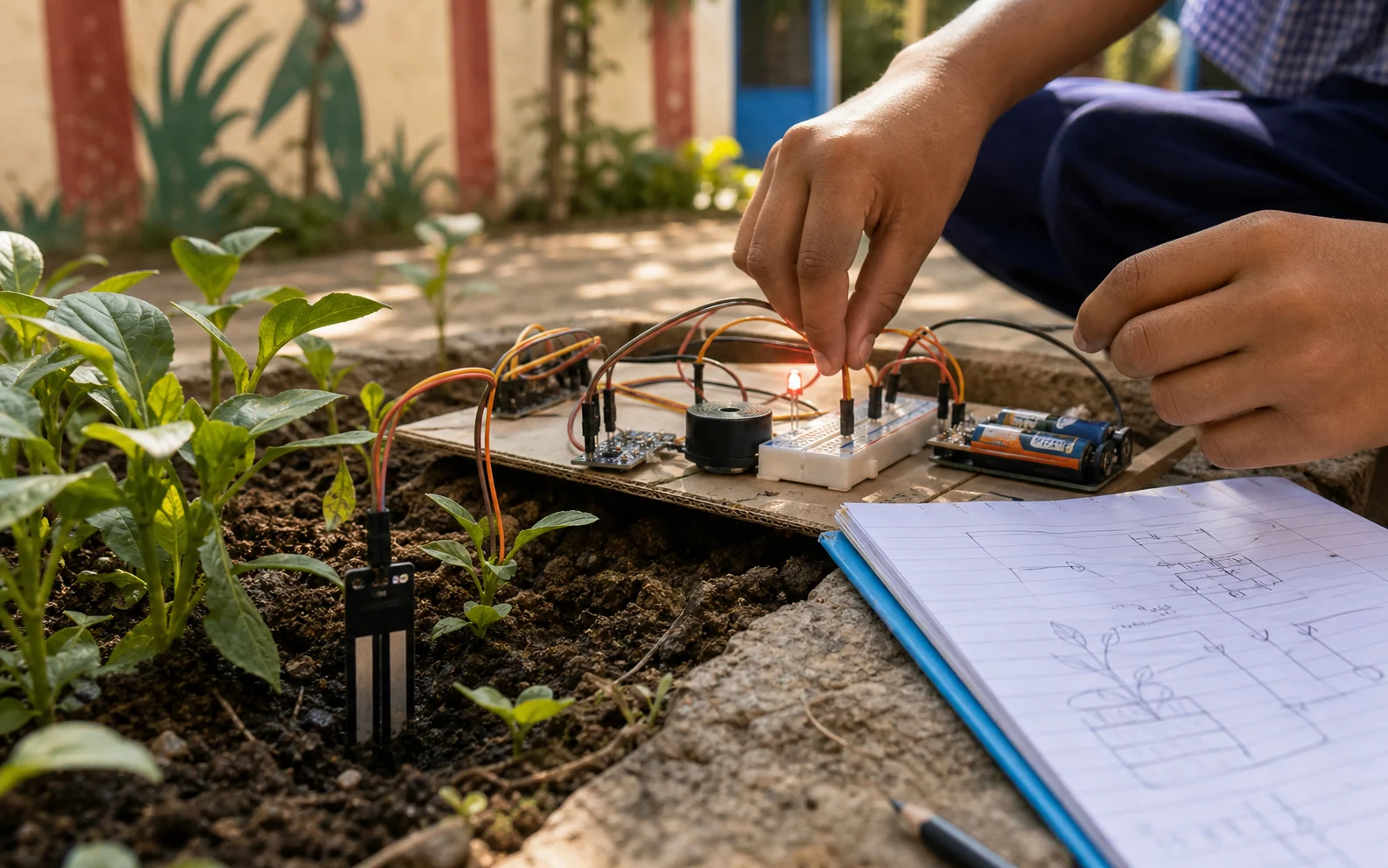
The trick is to keep the first build small enough for success and the second build open enough for ownership. First, students make the sensor work. Next, they decide where it belongs. Near a plant, in a water tank model, beside a classroom window, or at the edge of a playground. That second decision turns a task into a project.
- +Start each cycle with a real observation from the school or village.
- +Ask students to draw the problem before they draw the circuit.
- +Use one new concept per build so the lesson stays playable.
- +End with a community explanation, not only a teacher check.
The child becomes a local investigator
Problem-based STEM changes the role of the student. The child is no longer only receiving a chapter. The child is investigating a place. That shift is especially important for students who have been told, quietly or loudly, that modern technology belongs somewhere else.
A Class 7 team can map dark corners near the school and build a simple light sensor demo. A Class 8 team can compare soil readings from shaded and sunny areas. A Class 6 team can design a buzzer that warns when a model tank is full. None of these projects needs to be perfect. They need to invite better questions.
This is also where language opens up. Students can discuss the problem in the language they use at home, write labels in English if helpful, and present the final idea to parents or local leaders. The science becomes bilingual, social, and memorable.
Why this has learning value
Local projects are not just feel-good activities. They build serious habits: measurement, estimation, iteration, teamwork, public explanation, and design tradeoffs. Students learn that a sensor reading may be noisy, that wires need strain relief, that batteries run out, and that a prototype must survive the place where it will be used.
Maker education research increasingly points to inclusion and community context as essential parts of meaningful STEM learning. Students learn better when they can connect technical work with their own identity and environment. For rural classrooms, this is not a decorative idea. It is the heart of the model.
SFI can make this practical by building lesson packs around local themes: water, light, soil, health, transport, safety, and school operations. Each theme can have a beginner build, a challenge build, a reflection prompt, and a showcase script. That gives teachers structure while still giving students room to notice the world.
Sources and further reading
Read next
All notesWhy an Arduino Simulator Belongs in a Rural STEM Lab
How browser-based circuit simulation can protect limited kits, help teachers explain invisible logic, and give rural students more chances to practice.
Girls Need Protected Time With Tools
A practical case for designing rural STEM sessions where girls do not wait at the edge of the table while someone else builds.