Girls Need Protected Time With Tools
A lab is not fair because girls are invited into the room. It becomes fair when their hands get the tools, the time, and the trust.
1 rule
Every learner should get real tool time in every build cycle

Confidence does not grow from watching someone else hold the wire. It grows when a girl makes the connection, sees the result, and knows the next attempt is hers too.
Invitation is only the first step
Many programs proudly say that girls are welcome in STEM. That is necessary, but it is not enough. In a crowded classroom, the loudest student often grabs the breadboard. The fastest student takes the laptop. The child who has used a phone more often becomes the unofficial tech lead. Girls may be present and still be waiting.
Protected tool time fixes that quietly and powerfully. It means the session is designed so every learner must touch the real work. One girl connects power. Another reads the resistor value. Another edits the code. Another explains the failure. Roles rotate before habit turns into hierarchy.
For ages 5 to 12, this is especially important. Children build identity early. A girl who spends her first STEM sessions watching from the side may decide the lab is not for her. A girl who gets to press run, test the sensor, and present the result starts telling herself a different story.
Access is social, not only technical
ASER 2023 showed that rural youth are increasingly familiar with smartphones, but it also highlighted gender gaps in access, ownership, and confidence. That pattern should shape how we design STEM labs. If girls have had fewer chances to use devices at home, then the classroom must become a place where access is deliberately balanced.
UNESCO's work on girls and STEM makes the same larger point: participation depends on expectations, role models, classroom culture, and the way learning environments distribute opportunity. A kit on the table does not automatically remove old patterns. A thoughtful routine can.
The routine does not need to feel heavy. It can be as simple as a role card, a timer, and a rule that no one solves a team problem without hearing from the student holding the current role. Children understand fairness when it is visible.
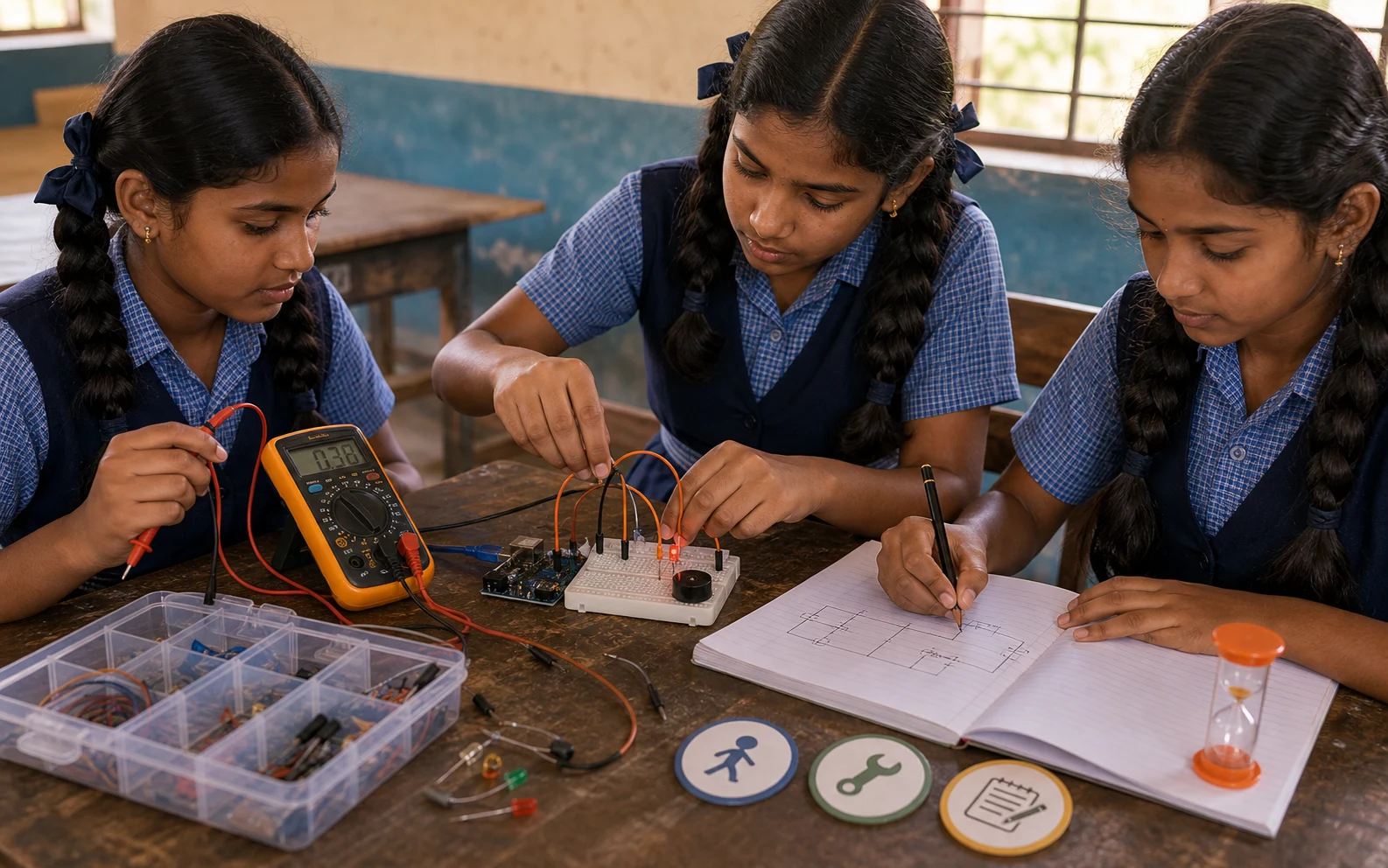
- +Rotate roles: builder, tester, note keeper, code reader, presenter, and debugger.
- +Let girls lead early wins, not only final decoration or note writing.
- +Use pairs before whole-team work so quieter students practice speaking.
- +Invite women mentors and older girls to demonstrate real pathways.
Make the table safer for first attempts
A child learns less when every mistake feels public. Girls who already feel watched may avoid the risky part of the build. They may pass the jumper wire to someone else, laugh off confusion, or choose the safe role of writing notes.
Good facilitation makes first attempts safer. The mentor can say, 'This is the testing round. We expect something to fail.' The teacher can ask every team to find one mistake before fixing anything. The class can celebrate clean debugging, not only the team that finishes first.
This is where SFI's tone matters. The lab should feel lively, but not chaotic. It should feel serious, but not intimidating. The goal is a room where a girl can be wrong, try again, and still feel like a builder.
A showcase can change who the village sees
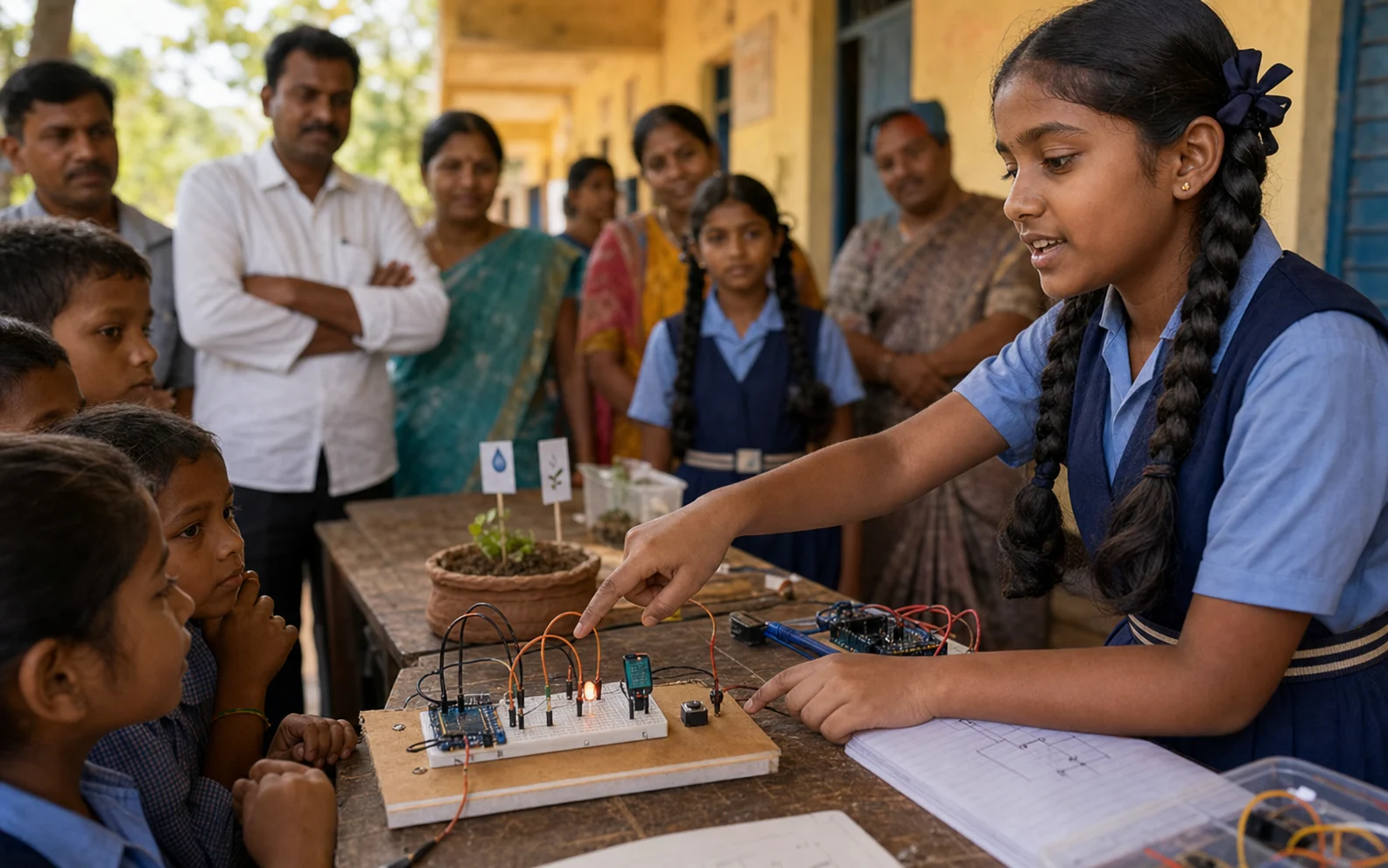
When girls present a working circuit to parents, teachers, and younger children, the lesson travels beyond the classroom. The community sees them holding the tool, naming the parts, explaining the logic, and answering questions. That public moment can do more for confidence than a private worksheet ever could.
Girls in ICT campaigns often focus on visibility for exactly this reason. Seeing girls and women in technology changes what younger learners think is normal. For rural STEM work, the showcase is not an optional celebration. It is part of the equity design.
The aim is not to make girls perform confidence. The aim is to give them enough real practice that confidence has somewhere honest to stand.
Sources and further reading
Read next
All notesWhy an Arduino Simulator Belongs in a Rural STEM Lab
How browser-based circuit simulation can protect limited kits, help teachers explain invisible logic, and give rural students more chances to practice.
Village Problems Make the Best STEM Projects
Why rural maker education should start with familiar problems and guide students toward prototypes they can explain to their own community.