Teachers Turn Digital Initiatives Into Daily Practice
Digital platforms, labs, and policies only reach children when a teacher can turn them into a calm, repeatable classroom rhythm.
15 lakh
Faculty members targeted by Malaviya Mission training from 2023-24 to 2025-26

The platform may carry the lesson, but the teacher carries the room. Any digital initiative that forgets this will look good in a brochure and weak in a classroom.
A teacher is the bridge
A new digital platform arrives. A simulator opens in the browser. A STEM kit sits on the table. The children are curious, but the room still needs a human rhythm. Who forms the teams? Who decides when to pause? Who makes the quiet child speak? Who turns one glowing LED into a question about power, ground, and logic?
That bridge is the teacher. Digital initiatives work when they respect the teacher's day, not when they add another complicated demand. A rural teacher may be handling mixed learning levels, tight schedules, limited devices, and pressure to finish the syllabus. The best technology helps that teacher move with confidence.
SFI's work should therefore treat teacher support as core infrastructure. Not a side workshop. Not a one-time orientation. Core infrastructure.
India has the policy direction
The National Education Policy 2020 calls for experiential learning, digital education, coding exposure, vocational connections, and technology use that improves teaching and learning. DIKSHA has become a national digital platform for school education, with resources for teachers and learners across states and languages. UDISE+ shows school computer and internet access rising, even though gaps remain.
These initiatives create a powerful opening. But a rural classroom does not change because a policy page exists. It changes when a teacher has a clear activity, working materials, local language support, a troubleshooting path, and the confidence to try again after a rough first session.
The lesson for SFI is simple: build tools that meet the teacher at the blackboard, the desk, the shared laptop, and the crowded lab table.
- +Make every lesson runnable in 35 to 45 minutes.
- +Provide a no-internet fallback whenever possible.
- +Give teachers exact pause points for questions and predictions.
- +Include repair notes for common circuit and browser problems.
Digital practice needs a routine
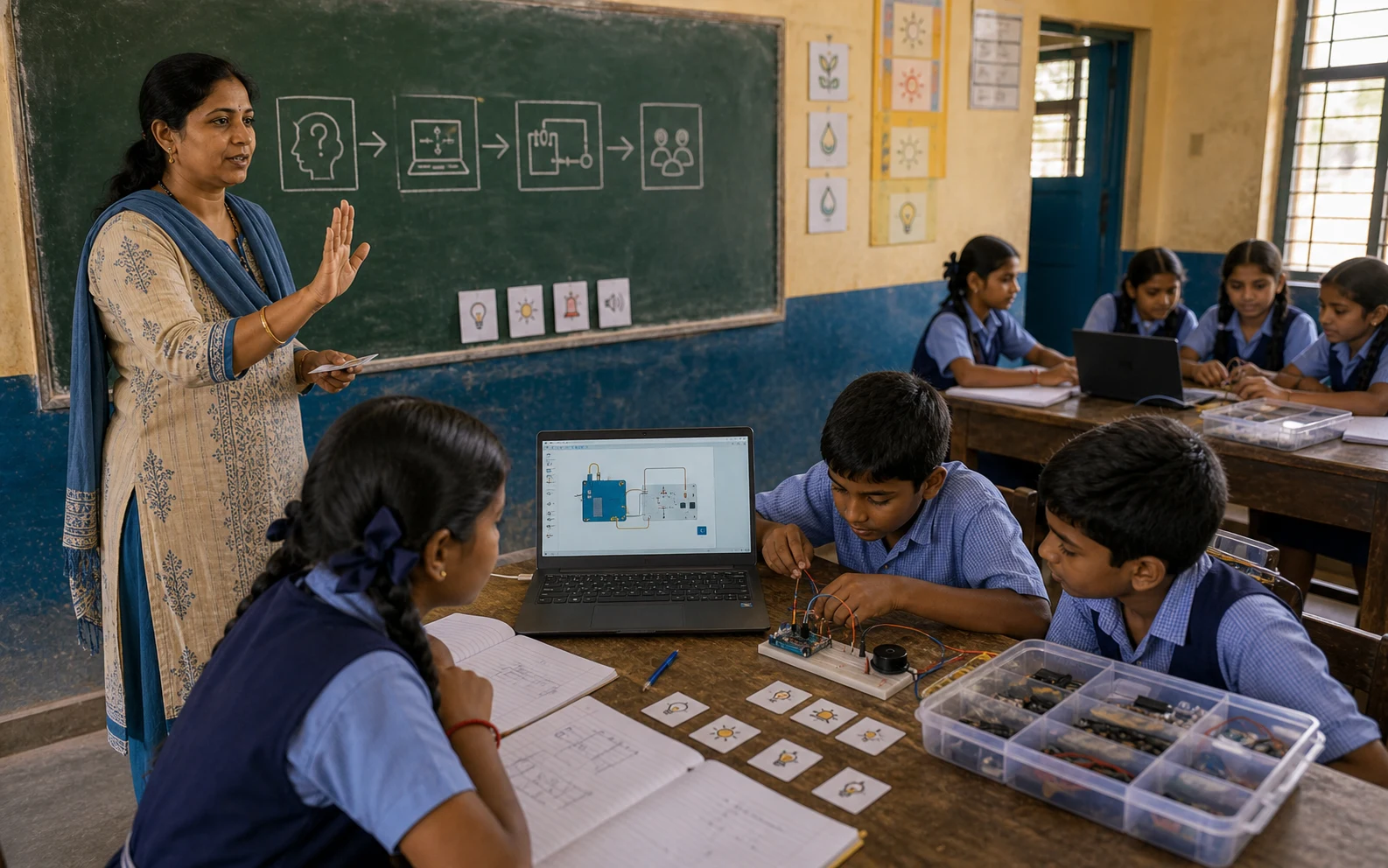
A good lesson routine feels almost like a story. First, the teacher names a local problem. Next, the class predicts what a circuit should do. Then students test the idea in the simulator. After that, they build the physical version. Finally, they explain what changed between the model and the real object.
That flow gives students a beginning, middle, and ending. It also gives teachers control. The simulator is not a random screen activity. The hardware is not a confusing pile of parts. The explanation at the end is not a rushed afterthought. Each piece has a place.
This is where digital initiatives become daily practice. The teacher does not need to invent the whole experience every week. The teacher needs a strong pattern that can be reused with LEDs, buttons, sensors, displays, motors, and local project challenges.
Training should feel close to the classroom
Large teacher-training programs show the scale of India's ambition. The Malaviya Mission Teacher Training Programme aims to reach around 15 lakh faculty members from 2023-24 to 2025-26 with NEP-oriented professional development. For school STEM work, the spirit of this investment should translate into smaller, practical support loops.
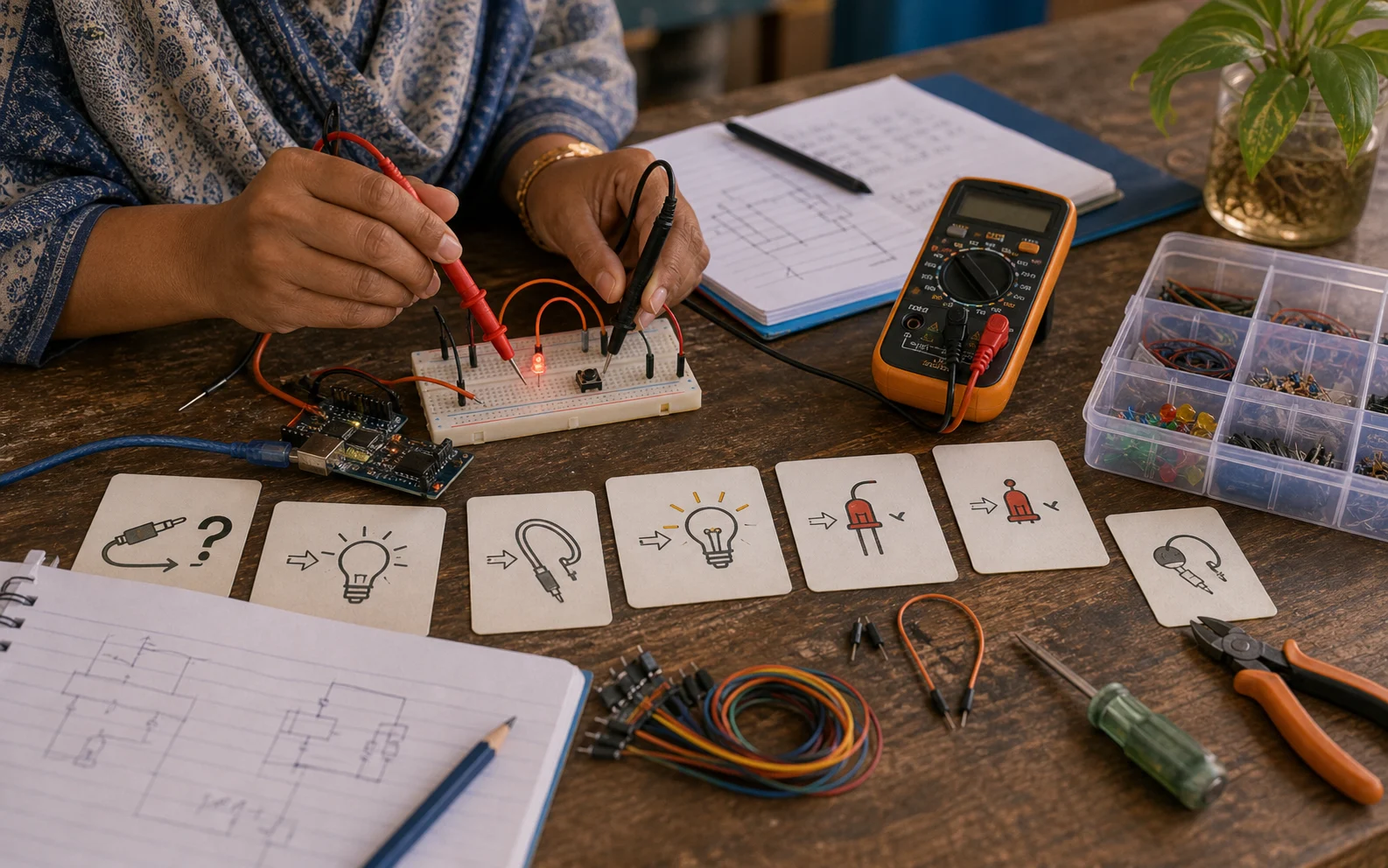
Teachers need short demonstration videos, printable lesson cards, common error guides, monthly mentor clinics, and examples from schools like theirs. A teacher should be able to ask, 'What do I do if the buzzer does not sound?' and get an answer that respects limited time.
The goal is not to turn every teacher into an electronics expert overnight. The goal is to help every teacher run a safe, lively, meaningful session where children build something and understand why it works.
What SFI can make next
SFI can build a teacher-first digital lab layer: simulator lessons, physical kit guides, classroom scripts, troubleshooting cards, and student reflection prompts. Each lesson should help the teacher tell a story that children can enter with their hands.
That is how digital India becomes visible at a school desk. Not as a slogan, but as a teacher saying, 'Try changing this wire. What do you think will happen?'
Sources and further reading
Read next
All notesWhy an Arduino Simulator Belongs in a Rural STEM Lab
How browser-based circuit simulation can protect limited kits, help teachers explain invisible logic, and give rural students more chances to practice.
Village Problems Make the Best STEM Projects
Why rural maker education should start with familiar problems and guide students toward prototypes they can explain to their own community.