The Student Showcase Is Part of the Learning
When students explain a prototype to parents and neighbors, the project stops being a private assignment and becomes a public act of confidence.
30
Top ATL Marathon innovations were showcased across real-world themes

A showcase is where a student stops saying, 'My teacher helped me make this,' and starts saying, 'Here is what we built and why it matters.'
The final table matters
At the end of a STEM cycle, there is often a table. On it sits a prototype with loose wires, a handwritten label, a notebook full of crossed-out ideas, and a student who knows more than they did four weeks ago. That table should not be hidden.
A showcase gives the project an audience. Parents see what their children can explain. Younger students see what they might build next year. Teachers see which teams understood the idea deeply. Local leaders see that the school is not only preparing children for exams, but also for problem-solving.
The learning does not end before the showcase. The showcase is learning.
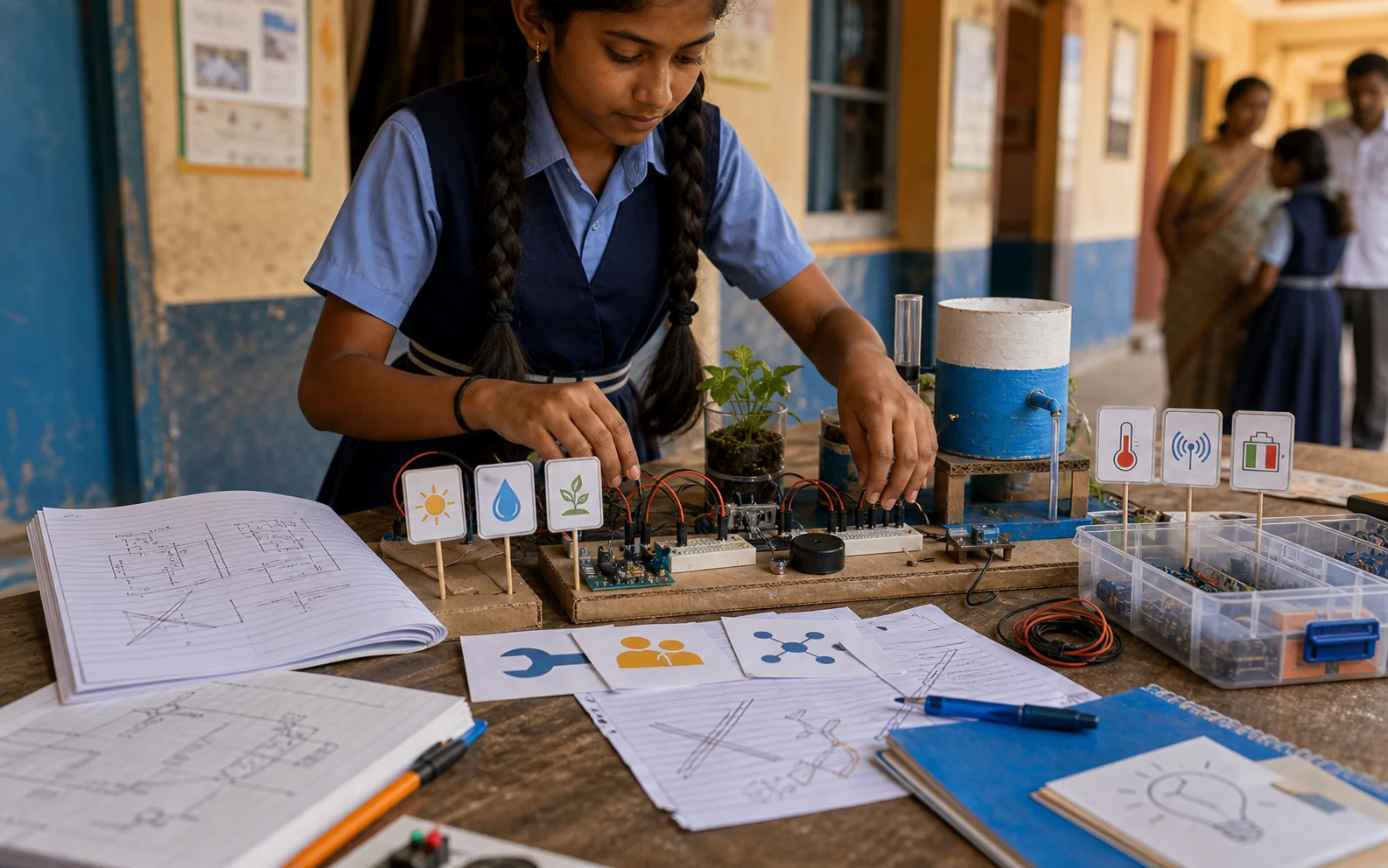
Explaining is engineering
A student who can make a circuit work has learned one thing. A student who can explain why it works has learned something deeper. A student who can explain it to a grandparent, a Class 3 child, and a teacher has learned to translate an idea across audiences.
That is a serious STEM skill. Engineers do it all the time. They move between technical detail and human need. A rural school showcase can introduce that habit early, without making it feel formal or intimidating.
The prototype gives the child something to stand behind. The explanation gives the child a voice.
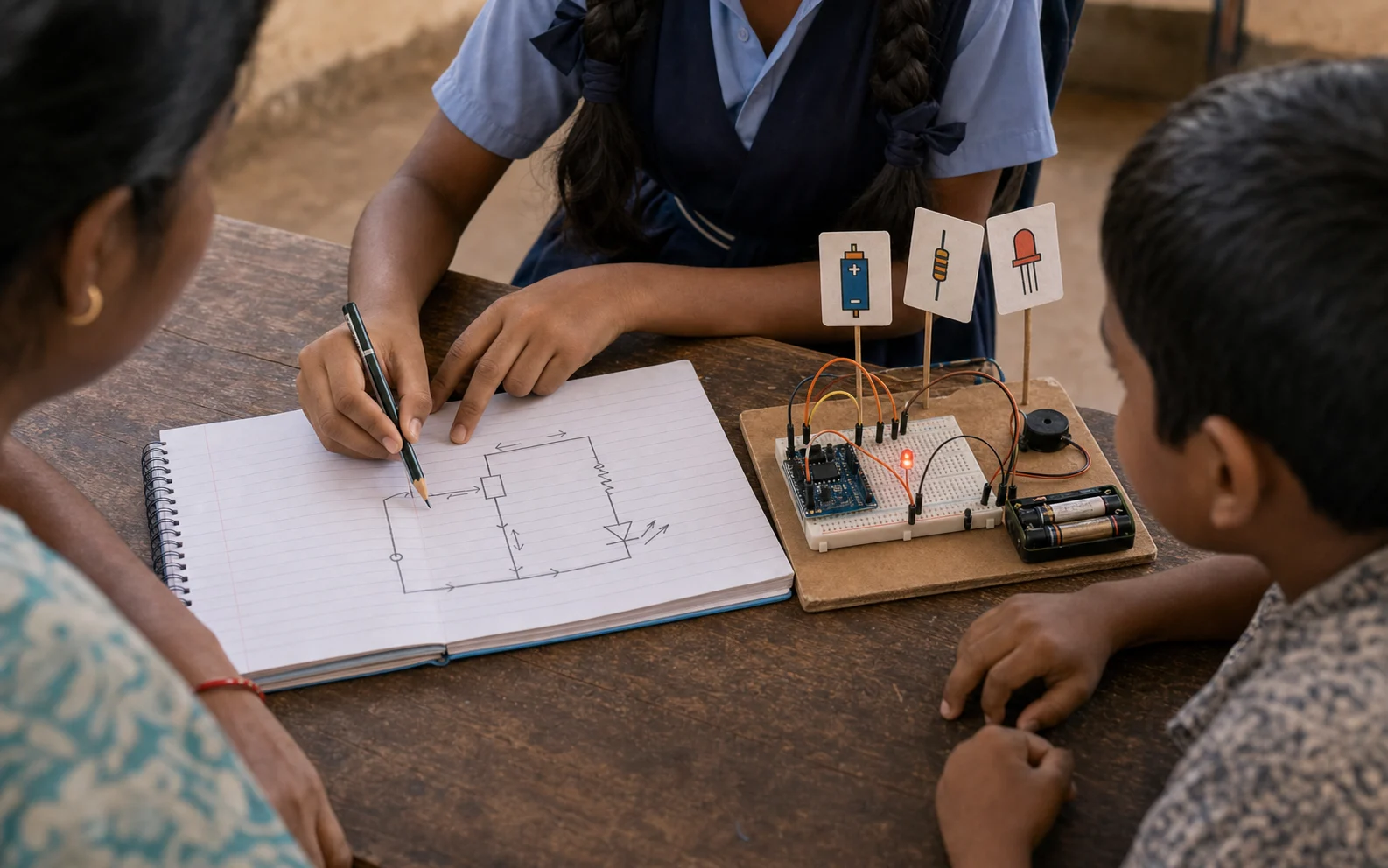
- +Ask each team to explain the problem before showing the circuit.
- +Require one sentence about what failed during the build.
- +Let every team member speak, even if only for one small part.
- +Invite younger students so the next cohort can imagine itself at the table.
Community trust grows when learning is visible
In many villages, parents may support education but still wonder what a STEM kit has to do with real life. A showcase answers that question better than a brochure. Students can show a water-level alarm, a soil sensor, a light model, or a safety buzzer and connect it to something the community already understands.
Public demonstrations also help girls and first-generation learners. When the community sees them presenting a working idea, the image of who belongs in technology begins to shift. The student is no longer only a child in uniform. The student becomes a maker in public.
Atal Tinkering Labs have used challenges, exhibitions, and showcases to make student innovation visible. SFI can learn from that pattern and scale it down for every school cycle, not only the biggest events.
Make it a ritual
The best showcase is not expensive. It needs working tables, simple labels, a speaking order, a repair box, and a few guiding questions. The class can invite parents for the last 30 minutes of the cycle. The school can photograph the builds and add them to a project wall.
When the ritual repeats, students begin with the end in mind. They know someone will ask what they built. They know they will need a reason, not only a result. That expectation makes the whole project stronger.
Sources and further reading
Read next
All notesWhy an Arduino Simulator Belongs in a Rural STEM Lab
How browser-based circuit simulation can protect limited kits, help teachers explain invisible logic, and give rural students more chances to practice.
Village Problems Make the Best STEM Projects
Why rural maker education should start with familiar problems and guide students toward prototypes they can explain to their own community.