Teach Science in the Language Children Think In
A child should not have to translate every question in their head before they can touch a wire, predict a result, or explain a mistake.
Grade 5
NEP 2020 recommends home or local language as medium of instruction where possible

The language of the lab should make the child braver, not quieter.
The idea should arrive before the English word
A child may understand light, heat, sound, water, speed, and balance long before they know the English terms in a textbook. When STEM begins only with unfamiliar vocabulary, the child has to solve two problems at once: the science problem and the language problem.
Local-language STEM does not mean lowering the standard. It means letting the idea enter through a door the child already knows. A teacher can say the concept in the home language, show the circuit, let students touch the parts, and then slowly attach the English label.
That sequence is humane and effective. The child first understands the behavior. The formal word comes after the experience has somewhere to sit.
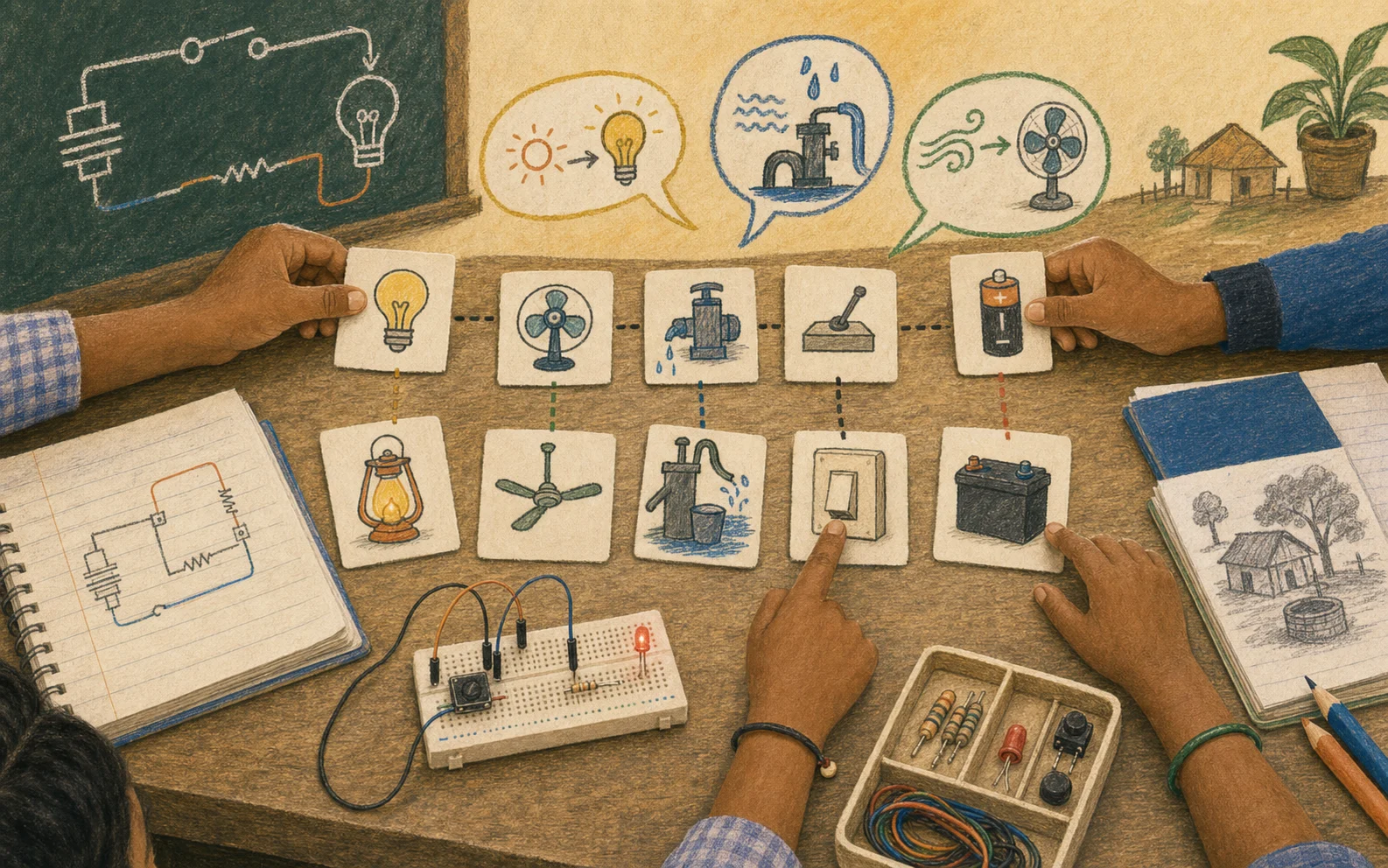
NEP gives this a strong foundation
The National Education Policy 2020 says young children grasp concepts more quickly in their home language or mother tongue and recommends the home, local, or regional language as the medium of instruction until at least Grade 5, wherever possible. It also calls for high-quality textbooks in home languages, including science.
This matters for rural STEM because the lab is full of moments that need quick explanation. Why did the LED glow? Why did the motor stop? What changed when the wire moved? A child should be able to answer first in the language that carries their thinking.
English can still be part of the journey. Students need the vocabulary of modern science and technology. But English should be a bridge, not a wall.
- +Use local words for the first prediction and explanation.
- +Add English labels after the student has seen the behavior.
- +Keep bilingual component cards in every kit.
- +Let students present in the language that makes their reasoning strongest.
The simulator can help too
A digital simulator gives SFI a chance to make language support visible. Component names can be simple. Instructions can be short. Hints can use familiar words. A student can click a wire and see a clear message about what is missing, instead of staring at a silent failure.
The best local-language support is not a giant translation layer pasted on top. It is a design habit. Avoid unnecessary jargon. Use the same phrase in the teacher guide, the simulator, and the student worksheet. Let the child hear, see, and use the concept in one steady voice.
That consistency is what turns vocabulary into confidence.
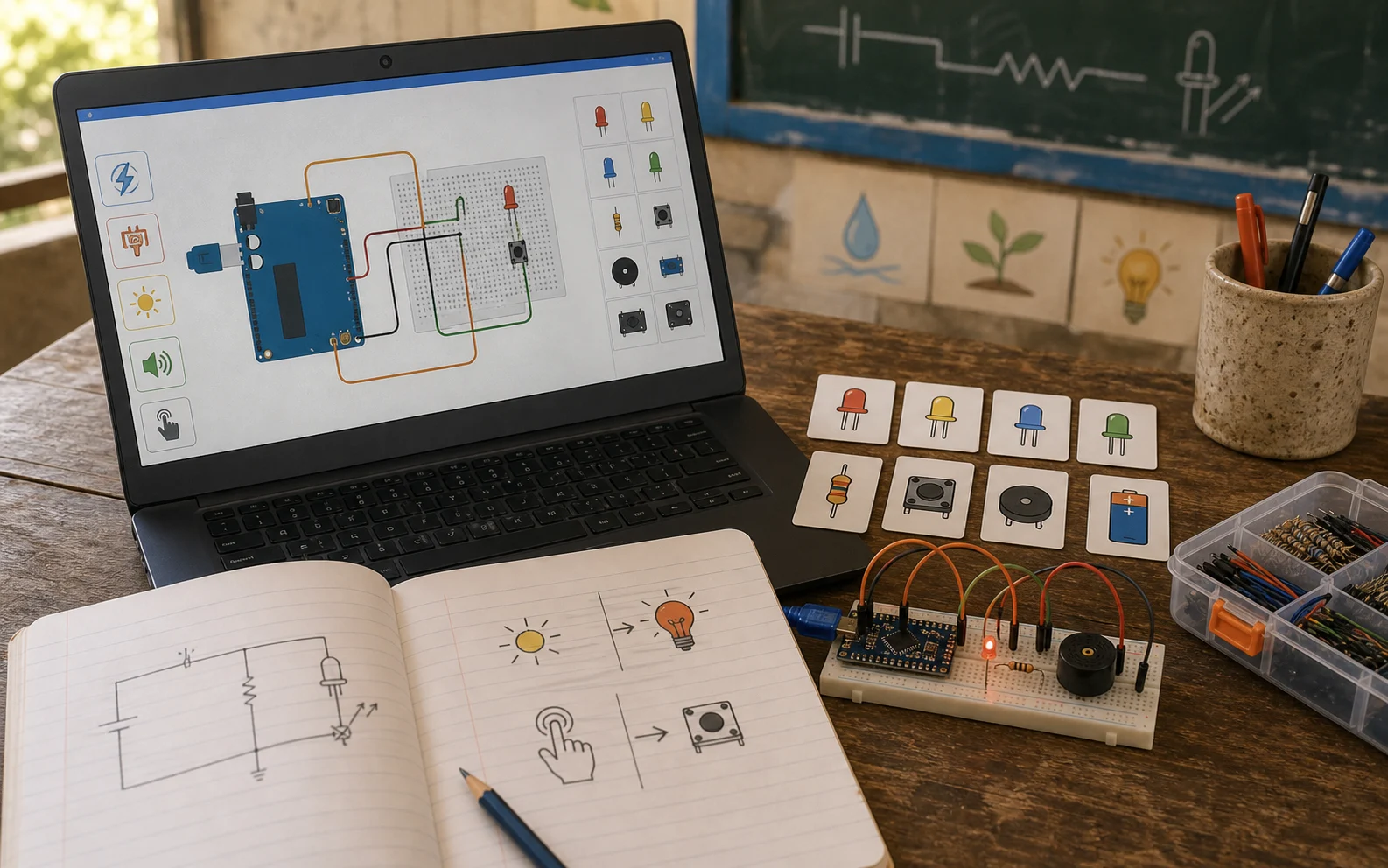
Language is belonging
When a child explains a circuit in their own language, the classroom changes. The idea no longer feels imported. The child can connect it to a pump, a bulb, a fan, a festival light, a field, or a kitchen switch. Science enters ordinary life.
For SFI, local-language STEM is not decoration. It is part of access. It tells rural learners that modern technology does not require them to leave their voice at the classroom door.
Sources and further reading
Read next
All notesWhy an Arduino Simulator Belongs in a Rural STEM Lab
How browser-based circuit simulation can protect limited kits, help teachers explain invisible logic, and give rural students more chances to practice.
Village Problems Make the Best STEM Projects
Why rural maker education should start with familiar problems and guide students toward prototypes they can explain to their own community.