Playful Science Before Big Words
For younger children, the first STEM lesson should feel like wonder with rules, not a vocabulary test with wires attached.
5-10
The age band where play can become the doorway to STEM habits

Before a child can name the principle, they can feel the pattern: push, pull, light, balance, spin, float, fall, try again.
Wonder comes first
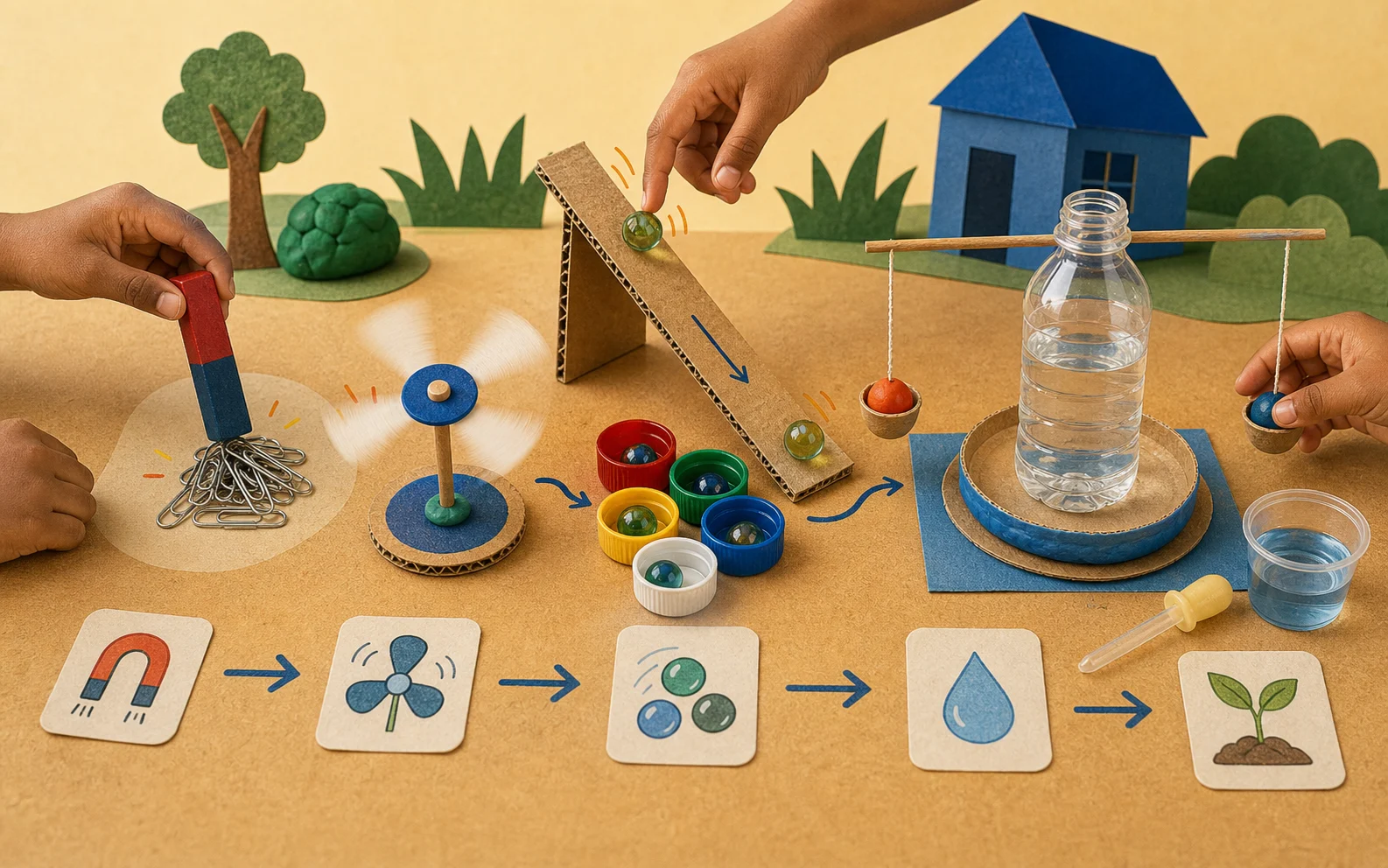
A five-year-old does not need to begin with the word electromagnetism. They can begin with a magnet that pulls a paperclip across a page. They do not need to define gravity before watching a cardboard ramp change a marble's speed. They do not need to name a circuit before seeing a tiny LED glow.
For younger children, science should begin as a safe surprise that invites a question. Why did it move? Why did it stop? What happens if we change the slope? What happens if we turn the battery around? These are the early roots of STEM thinking.
The job of the teacher is to protect that wonder while adding just enough structure. The child plays, notices, predicts, changes one thing, and tries again. That is already the shape of an experiment.
Low-cost can be high-quality
India has a long tradition of low-cost science learning. Eklavya's hands-on science work and Arvind Gupta's science toys show how everyday materials can become serious learning tools. Paper, cardboard, bottles, magnets, straws, rubber bands, thread, LEDs, and old boxes can carry surprisingly rich ideas.
This matters for rural classrooms because a program for ages 5 to 10 should not depend on fragile or expensive equipment. The first builds should be safe, repeatable, repairable, and easy for teachers to reset. Children should be able to make, break, and remake without fear.
The quality is not in the cost of the material. The quality is in the question the material helps a child ask.
- +Use everyday materials before specialized parts.
- +Make the first activity safe enough for small hands.
- +Ask children to predict with gestures, drawings, or simple words.
- +Move toward electronics only after the idea feels familiar.
How play leads to circuits
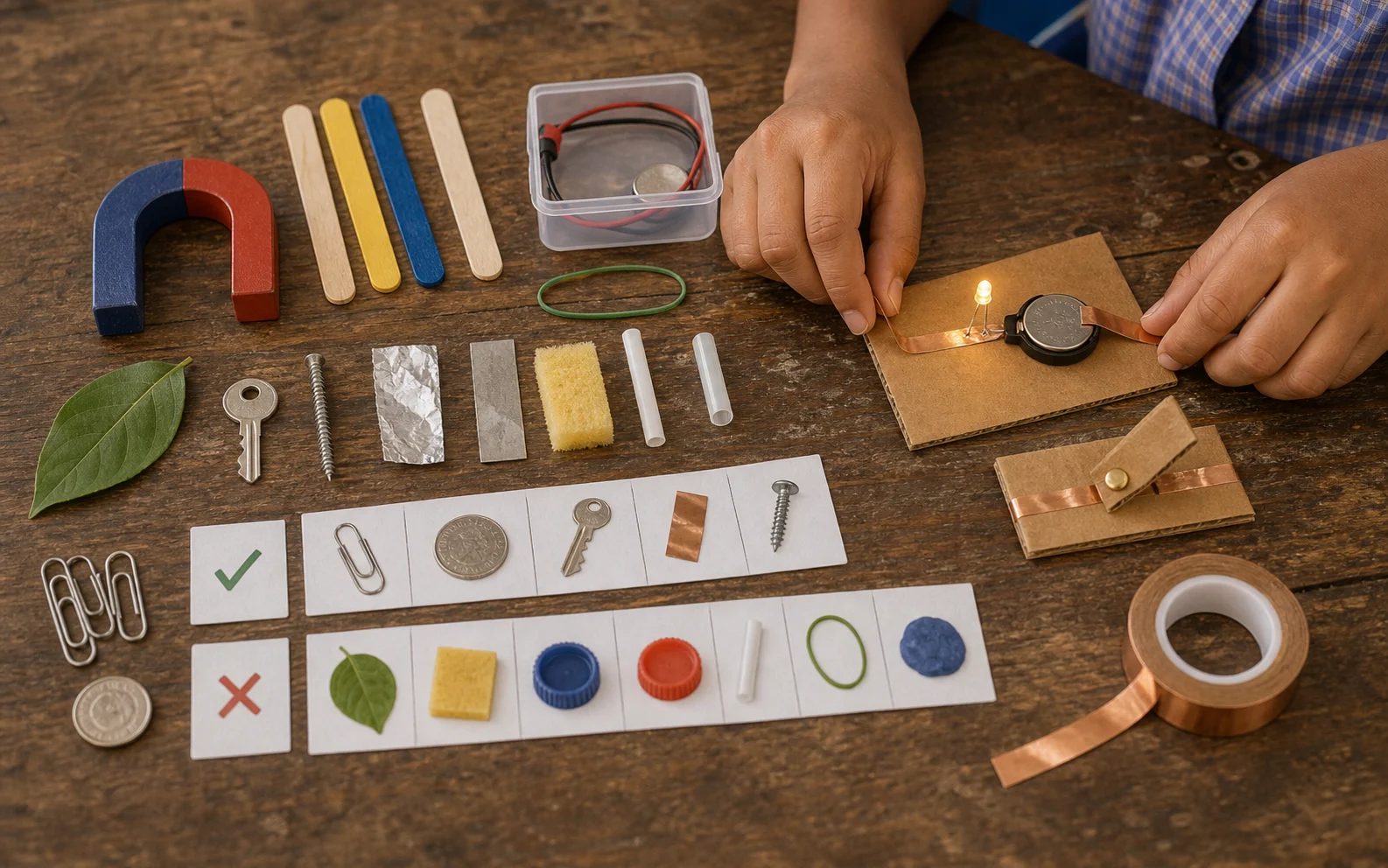
A playful STEM path can grow naturally. A child first explores push and pull with magnets. Later, they see a switch as a controlled action. A child first watches a spinner move in air. Later, they connect a motor. A child first sorts objects by whether they conduct. Later, they build a complete circuit.
This progression makes electronics less sudden. The breadboard is not the first strange object in the story. It is the next tool after many smaller discoveries.
SFI can use this sequence to design lessons for younger children that feel joyful and still prepare them for Arduino, sensors, and simulation when they are ready.
What learning looks like
In an early STEM room, success is not a perfect prototype. Success is a child who says, 'I think it will move faster if...' or 'It stopped because...' or 'Can I try another way?' The sentence matters. It shows that the child is beginning to reason.
The first STEM identity should be gentle: I can notice. I can try. I can change something. I can explain what happened. If SFI builds that identity early, the later lab work has a much stronger foundation.
Sources and further reading
Read next
All notesWhy an Arduino Simulator Belongs in a Rural STEM Lab
How browser-based circuit simulation can protect limited kits, help teachers explain invisible logic, and give rural students more chances to practice.
Village Problems Make the Best STEM Projects
Why rural maker education should start with familiar problems and guide students toward prototypes they can explain to their own community.